 English



General and Organic Chemistry Laboratory
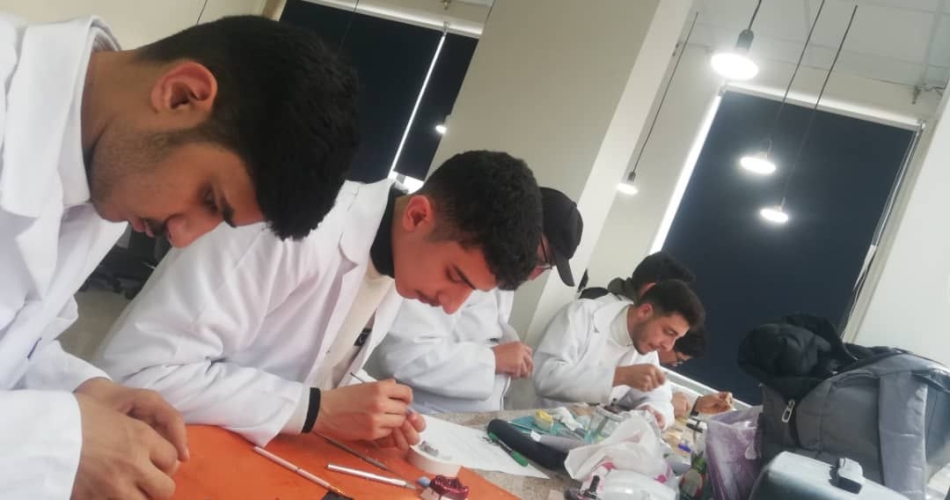
The General and Organic Chemistry Laboratory at the Faculty of Pharmacy, Qasyoun Private University, is the cornerstone of practical and research applications in the pharmaceutical curriculum. It bridges theoretical concepts with direct laboratory-based applications in the synthesis and analysis of chemical and pharmaceutical compounds.
Laboratory Objectives:
To impart essential skills: Training students in the safe handling of chemicals, glassware, and analytical instruments.
To connect theory with practice: Studying the properties of substances and chemical reactions (oxidation and reduction, titrations, organic synthesis, and the separation of compounds).
To prepare pharmaceutical personnel: Developing scientific thinking and the ability to accurately analyze laboratory results to qualify students for the stages of pharmaceutical development and manufacturing.
Essential Equipment and Supplies: The laboratory is equipped with a comprehensive set of modern equipment and instruments to ensure the efficient conduct of teaching and research:
Calibration and Measurement Devices: pH meters and analytical balances.
Photometric and Physical Analysis Equipment: UV-Vis spectrophotometers and refractometers. Separation and Distillation Equipment: Rotary evaporators, fractional distillation unit, and thin-layer chromatography (TLC) systems.
Thermal Control Equipment: Water and oil baths, hotplate/stirrers, and melt heaters for determining the purity of compounds.
Safety and Security Equipment: Fume hoods, eyewash stations, and emergency showers.
Courses and Practical Activities
The laboratory covers the practical aspects of several core courses during the first years of pharmacy studies:
General and Anhydrous Chemistry:
Preparation of solutions and chemical concentrations.
Study of volumetric titrations (acid-base, oxidation-reduction).
Rate of reactions and chemical equilibrium.
Organic Chemistry (1 and 2):
Identification of functional groups in organic compounds.
Methods of separation and purification (crystallization, distillation, extraction). Synthesis of some simple organic and pharmaceutical compounds (such as aspirin and paracetamol).
Study of the physical and chemical properties of alcohols, aldehydes, ketones, and carboxylic acids.
Laboratory Safety and Security Standards
The laboratory adheres to strict rules to ensure the safety of students and faculty:
Strict compliance with laboratory attire (white lab coat, safety goggles, and gloves).
Handling of volatile and hazardous materials exclusively within fume hoods.
Safe disposal of chemical waste according to environmental and pharmaceutical standards.