 English



Physics Laboratory
The Physics and Medical Physics Laboratory at the Faculty of Pharmacy, Qasyoun Private University, is a crucial foundational laboratory, serving as the primary bridge connecting fundamental physical phenomena and principles with pharmaceutical and physiological sciences, as well as modern diagnostic and analytical techniques.
Laboratory Objectives:
Establishing a Foundation in Physical Principles: Training students to understand and examine fundamental physical phenomena (such as light, sound, electricity, and heat) and their applications in the human body.
Understanding the Mechanisms of Medical and Pharmaceutical Devices: Introducing students to the physical principles underlying pharmaceutical analysis equipment (such as spectrometers, viscometers, and radiology and diagnostic devices).
Mastering Measurement and Processing Skills: Training students to accurately perform physical measurements, calculate error rates, and document data and graphs.
Basic Equipment and Tools:
The laboratory contains a range of instruments and model experiments designed to measure and study physical phenomena:
Optics and Light Equipment:
Optical microscopes and refractometers. Polarimeters for studying the optical activity of pharmaceutical compounds.
Lens, mirrors, and prism systems for measuring refraction, diffraction, and light scattering.
Mechanical and fluid flow equipment:
Viscometers for measuring various liquids and pharmaceutical solutions.
Surface tension meters using capillary tube or force methods.
Instruments for studying density, continuity laws, and fluid flow.
Electrical and medical physics equipment:
Electrical conductivity and resistivity in solutions.
Ultrasound and ultrasound models.
Radiation models and equipment for studying radiation diffraction and radiation safety.
General measuring equipment: Precision balances, digital thermometers, and stopwatches. Practical Courses and Activities
The laboratory covers the practical aspects of the Physics and Medical Physics course:
Physical Properties of Solutions and Liquids:
Measuring the viscosity of liquids and the effects of temperature and concentration on it.
Measuring the surface tension of solutions and its applications in pharmaceutical formulation.
Studying capillary and osmosis phenomena.
Optics and Photometric Analysis:
Measuring the refractive index of sugar and pharmaceutical solutions to determine their concentration and purity.
Studying the deflection and angle of rotation of polarized light for optically active organic and pharmaceutical compounds.
Studying the laws of lenses and applications of optical microscopes.
Electrical, Wave, and Biophysics:
Studying the electrical conductivity of ionic solutions.
Studying the properties of ultrasound waves and their applications in medical diagnosis and treatment.
Measuring and correcting measurement and experimental errors and performing physical titrations.
Safety Standards and Laboratory Practices
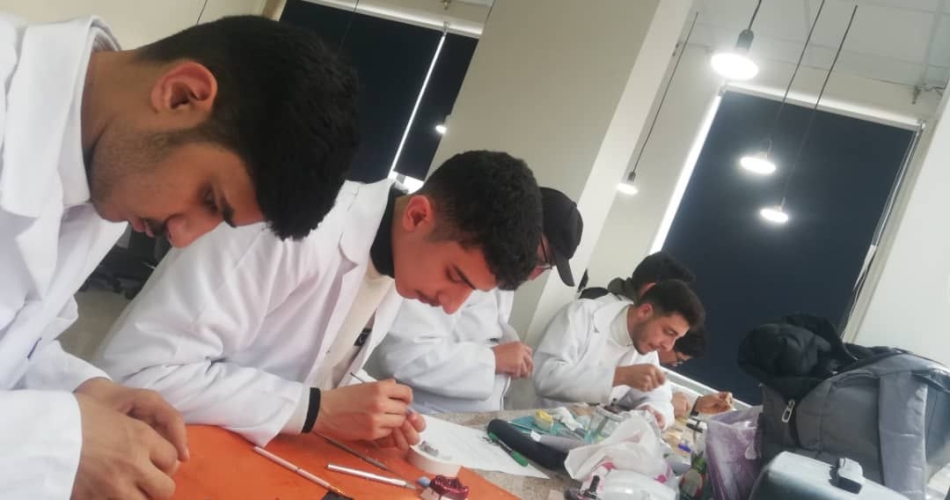
Adherence to laboratory work procedures and wearing protective clothing (white lab coat).
Handling delicate optical instruments and small glassware with care. Maintaining the accuracy of the results and recording the readings in a scientific and systematic manner.