 English




Analytical, Organic, and General Chemistry Laboratory
The General, Organic, and Analytical Chemistry Laboratory is the cornerstone and foundation of scientific and applied education in the Faculties of Pharmacy and Science. It combines fundamental chemical concepts with quantitative and qualitative analytical skills, and applications in synthesis and identification of organic compounds.
Laboratory Objectives:
Establishing fundamental chemical principles: Training students to handle chemicals directly, prepare solutions accurately, and understand the behavior of chemical reactions.
Mastering chemical analysis methods: Learning classical and instrumental methods for identifying chemical substances and determining their concentrations and purity.
Understanding and synthesizing organic compounds: Studying functional groups and applying separation, purification, and organic synthesis methods for pharmaceutical and chemical compounds.
Essential Equipment and Supplies:
The laboratory contains a comprehensive set of analytical and preparative equipment and instruments:
Calibration and precision measuring devices:
High-precision analytical balances.
Hydrogen meters and electrical conductivity meters.
Refractometers. Separation and Analysis Equipment:
Rotary Evaporators.
Natural, Fractional, and Steam Distillation Equipment.
Thin-Layer Chromatography (TLC) Systems and Ultraviolet (UV) Cabinets.
Thermal and Physical Control Equipment:
Melting Point Instruments for verifying the purity of organic compounds.
Hotplates/Stirrers, Water and Oil Baths.
Centrifuges and Sample Mixers.
Safety and Protection Equipment: Fume Hoods, Eyewash Stations, and Emergency Showers.
Course and Practical Activities:
The laboratory covers the advanced practical aspects of three main chemical areas:
General Chemistry:
Preparation of solutions and determination of concentrations (molarity, normality, and percentages).
Study of chemical equilibrium, reaction rates, and thermal reactions. Study of the properties of aqueous and electrolyte solutions.
Analytical Chemistry:
Qualitative Analysis: Detection of positive ions (cations) and negative ions (anions).
Quantitative Volumetric Analysis: Volumetric titrations (acid-base, oxidation-reduction, precipitation titration, and complex-forming titration).
Gratiometric Analysis: Precipitation, drying, and weighing of compounds to accurately determine their proportions.
Organic Chemistry:
Detection of functional groups (golates, aldehydes, ketones, carboxylic acids, and amines).
Separation and purification processes (recrystallization, solvent extraction, and distillation).
Basic organic synthetic reactions (e.g., esterification, alkylation, and halogenation).
Laboratory Safety and Security Standards:
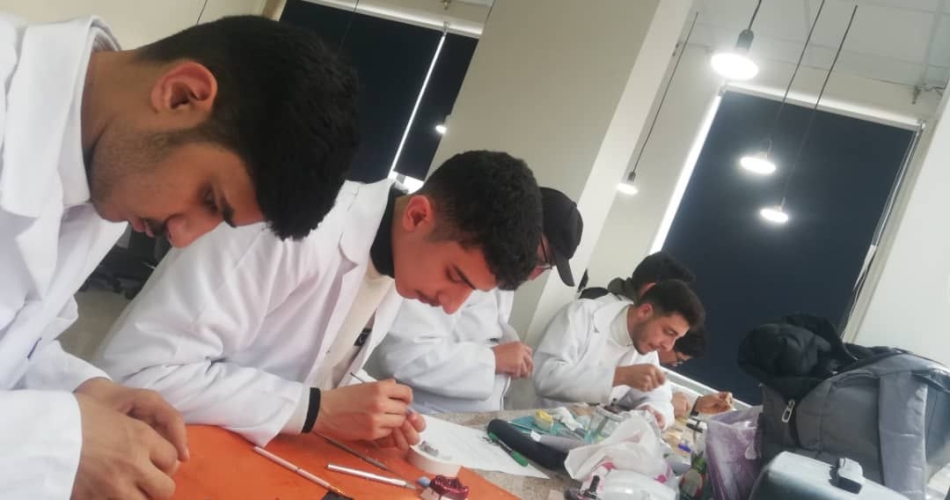
Strict adherence to laboratory safety protocols (wearing a white lab coat, protective gloves, and eye protection). Reactions that produce fumes or require volatile solvents must be conducted exclusively within fume hoods.
Chemical waste (organic solvents, strong acids and bases, and solids) must be classified and disposed of according to approved environmental and health regulations.