 English

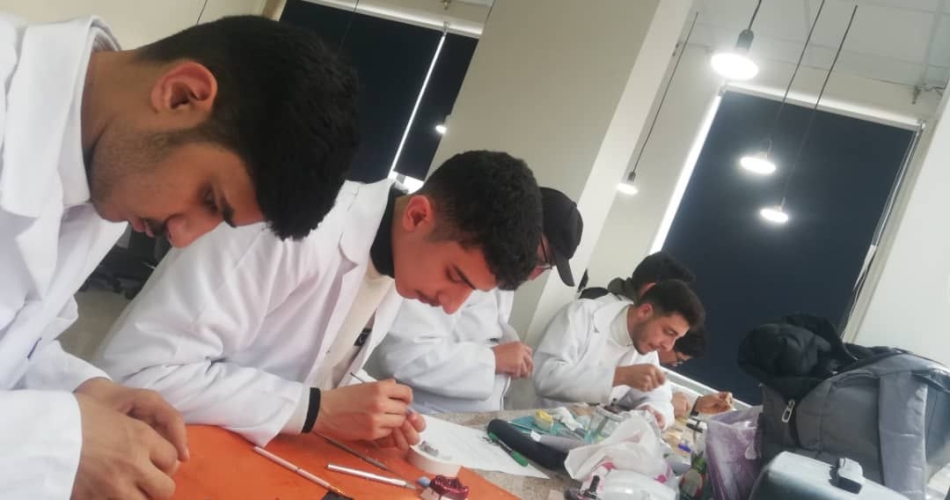


Pharmacy laboratory
The Pharmaceutics/Physical Pharmacy Lab at the Faculty of Pharmacy, Qasyoun Private University, serves as the primary pathway for students to practice basic and physical pharmaceutical sciences. It focuses on understanding the physicochemical properties of pharmaceutical and excipient materials and how to formulate them into primary pharmaceutical forms according to the principles of the pharmacopoeia.
Laboratory Objectives:
Establishing the concepts of pharmaceutical formulation: Understanding the physical and chemical behavior of active ingredients and excipients during preparation.
Mastering Galenic formulation (drug compounding): Training students to accurately prepare basic pharmaceutical formulations and calculate dosages.
Studying primary pharmacokinetics and pharmacodynamics: Understanding the factors of solubility, stability, and absorption and their impact on drug efficacy.
Essential Equipment:
The laboratory is equipped with the necessary equipment for studying the physical properties of pharmaceutical dosages and preparing them at the laboratory level:
Physical Properties Analysis Equipment:
Viscometers for measuring viscosity and pharmaceutical flow.
Surface Tension Meters. Particle Size Analyzers.
Preparation and Formulation Equipment:
Homogenizers and Stirrers for Solutions and Emulsions.
Hotplates and Stirrers with Magnetic Stirring and Precision Temperature Control.
High-Precision Pharmaceutical and Analytical Balances.
Testing and Stability Equipment:
PH and Conductivity Meters.
Evaporators and Temperature-Controlled Water Baths.
Reverse Osmosis and Water Distillation Equipment for Purified Water Preparation.
Courses and Practical Activities:
The laboratory covers the practical aspects of Pharmaceutics (1, 2, 3) and Physical Pharmacy courses:
Physical Pharmacy and Surface Phenomena:
Study of Solubility and Factors Increasing It (Pyrolysis, Co-Solvents).
Measuring Surface Tension and Using Surfactants. Study of colloidal phenomena and the flow of powders and liquids (Rheology).
Basic pharmaceutical forms and mixing:
Preparation of aqueous, alcoholic, syrups, and elixir solutions.
Formulation of suspensions and testing of their settling rate and stability.
Preparation of emulsions and study of the emulsion type (oil/water or water/oil) and stability.
Topical semi-solid forms:
Preparation of ointments, creams, and gels.
Study of the penetration of pharmaceutical substances through membranes and the effect of the ointment base on release.
Safety and Good Pharmaceutical Practice (GPPP) Standards:
Adherence to GPPP principles and accurate pharmaceutical dosage calculations.
Wearing protective laboratory attire and careful handling of chemicals and organic solvents.
Accurate documentation of preparation steps and storage of pharmaceutical samples under appropriate stability conditions.