 English




General Anatomy and Head and Neck Anatomy Laboratory
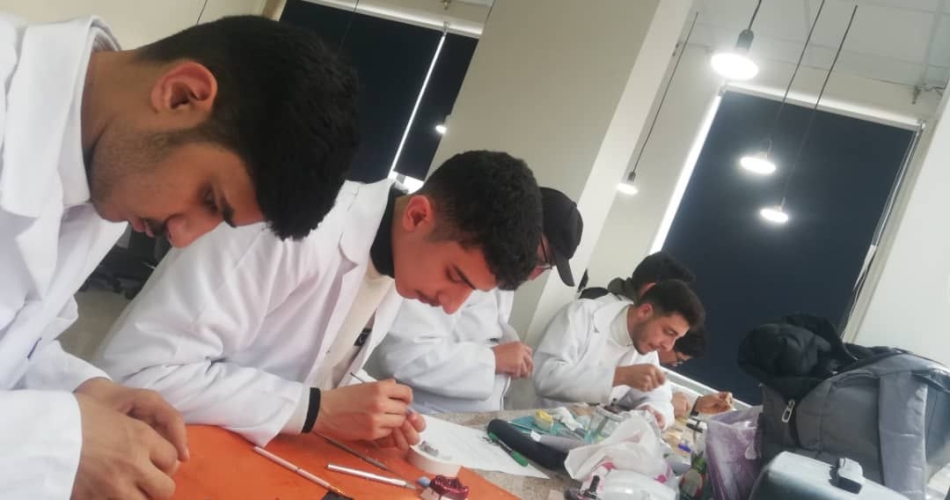
The General Anatomy and Head and Neck Anatomy Laboratory at the Faculty of Dentistry, Qasyoun Private University, provides the foundational knowledge base for medical and dental students. It focuses on the morphological and structural analysis of the human body in general, with a detailed and precise emphasis on the head, neck, and jaw regions.
General Objectives of the Laboratory:
Understanding the Anatomical Structure of the Human Body: Studying the organs and systems that comprise the human body and the spatial relationships between them.
Deep-seated Anatomy of the Head and Neck: Comprehending the complex topography of the skull, neural pathways, blood supply, and lymphatic drainage of the facial and maxillofacial regions.
Bridging Anatomy with Clinical Application: Preparing students for local anesthesia, maxillofacial surgery, and various dental treatments based on a thorough understanding of the biological structures embedded in the head and neck.
Equipment and Teaching Aids:
Three-Dimensional Anatomical Models: Deconstructed, high-resolution plastic models depicting parts of the brain, eye, ear, neck, and thoracic and abdominal organs. Human and Artificial Skulls and Skeletons: Skull models with detachable sections for studying superficial and basal bones, neural foramina, and vascular pathways.
Histological and Anatomical Slides and Interactive Displays: Interactive displays and high-resolution microscopes illustrating transverse and longitudinal anatomical sections of the face and neck.
Muscular and Nerve Simulation Models: Models illustrating the precise pathways of the trigeminal neural network and facial nerve, as well as the muscles of mastication and facial expression.
Student Training Topics and Skills
General Anatomy:
Study of the major biological systems: skeletal, muscular, circulatory, respiratory, and nervous systems.
Identification of internal organs and the major anatomical relationships between body systems.
Head and Neck Anatomy:
Skull and Facial Bones: Study of the maxilla and mandible, sphenoid bone, ethmoid bone, and temporomandibular joint (TMJ). Cranial Nerves: Special focus on the trigeminal nerve (cranial nerve V) and its three branches, the facial nerve (cranial nerve VII), and their distribution in the oral tissues.
Blood Supply and Drainage: Study of the external carotid artery and its branches supplying the jaws and teeth, and venous return and lymphatic drainage of the neck and face.
Oral and Facial Muscles: Study of the muscles of mastication (masseur, temporal, and pterygoid), facial expression muscles, and muscles of the tongue and pharynx.
The Importance of the Laboratory in the Clinical Process: This laboratory is a fundamental pillar upon which the dentist relies throughout their career. The successful administration of local anesthesia, the performance of maxillofacial surgical procedures, and the management of maxillofacial pain depend entirely on a thorough understanding of the anatomical connections provided by this laboratory.