 English




Dental drawing and carving laboratory
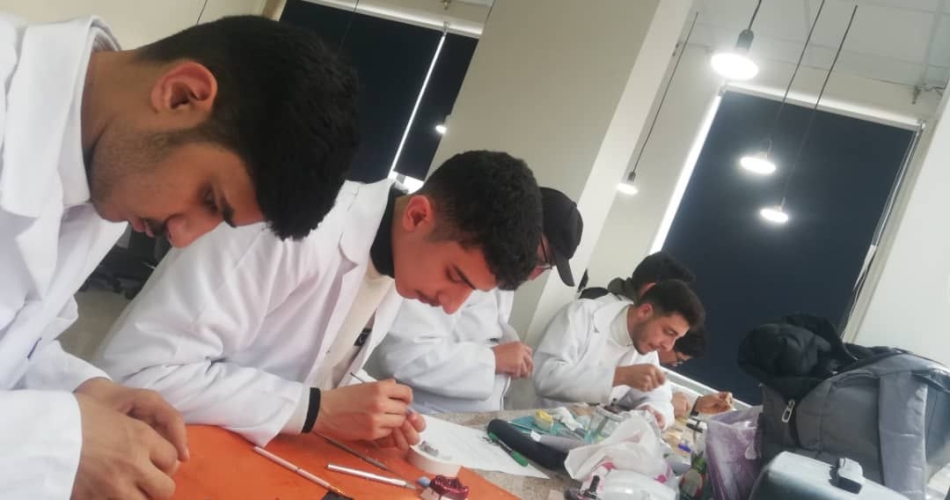
The Dental Drawing and Sculpting Lab provides the foundational scientific and aesthetic experience for dental students and those studying prosthodontics. Here, students learn to translate theoretical concepts of tooth morphology (shape and topography) into highly accurate three-dimensional models and sculptures that mimic natural teeth.
General Lab Objectives:
Understanding Tooth Morphology and Topography: Studying the fine details of teeth (cusps, grooves, margins, and cusps) for both permanent and primary teeth.
Developing Artistic Sense and Manual Dexterity: Training students to precisely control their hands and sculpting tools to achieve accurate micrometer-level measurements and dimensions.
Mastering Two-Dimensional Drawing: Drawing teeth with their correct dimensions and axes before sculpting to create an accurate spatial representation of the tooth.
Preparing for Advanced Stages: Building a solid foundation for the waxing of fixed and removable prostheses and the preparation of dental cavities in later years. Educational Equipment and Resources
Wax Carvers: Such as tools from P.K. Thomas, Le Cron, and Beale, designed for adding, carving, and shaping wax.
Wax Blocks: Blocks in various colors and hardness levels used for carving at scale or to scale.
Typodonts and Giant Tooth Models: Three-dimensional models showing the five dimensions of each tooth (occlusal, buccal, lingual, mesial, and distal).
Dental Drawing Books and Tools: Graph paper and diagrams for learning tooth projections, root angles, and acanthosis.
Student Training Topics and Skills
Structural Drawing of Teeth: Drawing different projections of the tooth (buccal, lingual, mesial, distal, and occlusal surfaces) on drawing paper, taking into account common proportions and dimensions. Large-Scale Wax Carving:
Tooth carving on wax cubes at magnified scales (e.g., two or three times the normal size) to highlight fine anatomical details such as major and minor grooves and cusps.
1:1 Ratio Tooth Carving:
Training students to carve a full-size tooth to match human teeth, ensuring accurate size and contact points with adjacent teeth.
Occlusion Studies:
Understanding how the cusps of the upper and lower teeth interlock (occlusion) and the effect of tooth shape on jaw mechanics.
The Importance of the Laboratory in Academic and Professional Development:
The dental drawing and carving laboratory is a cornerstone of dental and prosthodontic studies. A dentist or technician who lacks an accurate visualization of the correct anatomical shape of the tooth will be unable to restore both tooth function and natural aesthetics during cavity treatment or the fabrication of ceramic and wax restorations.