 English


Gypsum laboratory
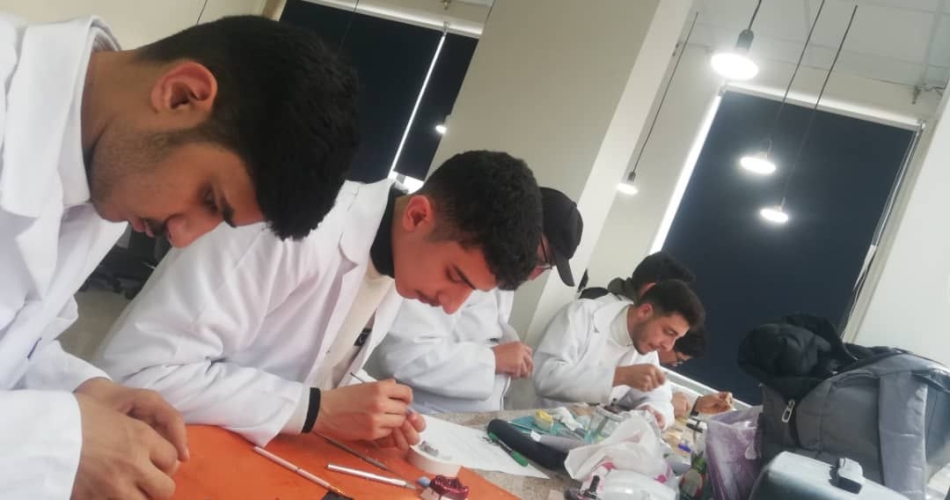
The Plaster Laboratory at the Faculty of Dentistry, Qasyoun Private University, provides a fundamental training environment equipped for working with plaster materials and preparing casts. It serves as the primary station for preparing dental casts and models, which form the basis for clinical treatments and diagnostic planning across various dental specialties.
General Objectives of the Laboratory:
Understanding the Properties of Dental Plaster Materials: Studying the physical and chemical behavior of different types of dental plaster (hardening, thermal expansion, and rigidity).
Accurate Transfer of the Clinical Field: Training students to cast impressions taken from the patient's mouth without air bubbles to ensure accurate representation of the model.
Preparation of Diagnostic and Working Models: Producing orthodontic, diagnostic, and diework models used in the fabrication of appliances and prostheses.
Available Equipment and Technologies:
Vacuum Mixers: For mixing plaster under vacuum to reduce bubbles and increase rigidity and cohesion.
Dental Vibrators: Used to remove trapped air and agitate the plaster during impression casting to ensure the material flows smoothly in the finest details.
Model Trimmers: Water-powered cutting devices used to trim and frame plaster models according to standard measurements.
Precision Scales and Measures: Used to ensure the precise water-to-powder ratio according to the manufacturer's specifications.
Pindex Systems/Die Saws: Equipment used to divide the model into separate teeth that can be detached and fitted into fixed prostheses.
Student Training Topics and Skills:
Working with Dental Plaster Grades:
Plain Plaster (Type II): For fixation to the socket and for initial models.
Stone Plaster (Type III): For removable prosthesis models and study models.
Die Stone Plaster (Type IV/V): For precise modeling in crowns, bridges, and orthodontics. Pouring and Trimming: Pouring alginate and silicone impressions, and geometrically trimming the bases of gypsum models.
Articulator Mounting: Transferring the mandibular relationships and fixing the gypsum models to the articulator for occlusal analysis.
Die Preparation: Sectioning the workpiece and isolating the margins to facilitate subsequent waxing of the restorations.
Safety and Maintenance Standards
Gypsum Traps: Filtration systems to prevent the blockage of drainage pipes by gypsum residue during washing and trimming.
Personal Protective Equipment: Wearing masks and safety goggles is mandatory to protect the respiratory system and eyes from gypsum dust and flying debris.