 English


Dental Anatomy and Anatomy Laboratory
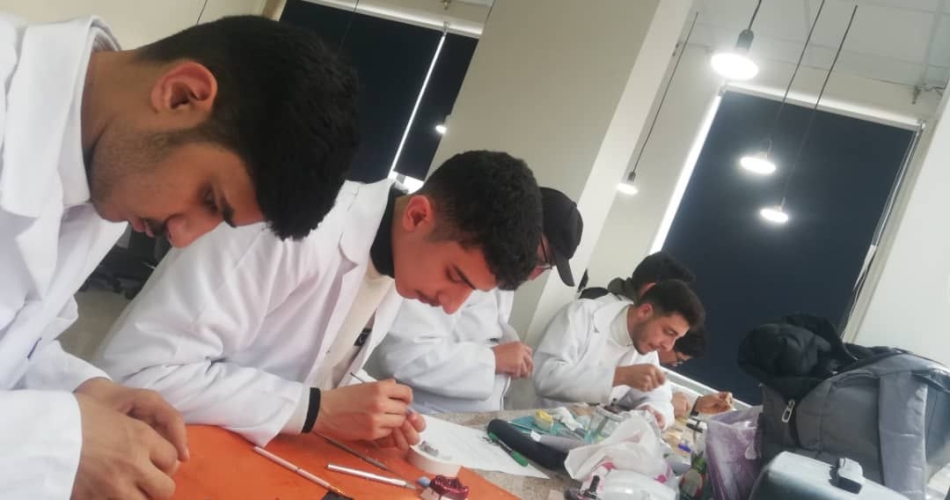
The Dental Anatomy and General Anatomy Laboratory at the Institute of Prosthodontics, Qasyoun Private University, provides the institute's students with their first scientific and practical foundation. Here, students learn about the structural and morphological composition of all human teeth, as well as the anatomical features of the head, neck, and jaws. This enables them to simulate and fabricate dental prostheses that closely resemble natural models.
General Objectives of the Laboratory:
Understanding Dental Morphology: Studying the intricate details of dental topography (cusps, grooves, cusps, and curves) for each individual tooth.
Developing Manual Skill and Artistic Appreciation: Training students in the principles of sculpting to translate theoretical knowledge of dental form into tangible reality.
Linking Anatomy and Prosthodontics: Understanding occlusal relationships, the anatomical boundaries of the jaws, and the impact of tooth shape on facial function and aesthetics.
Equipment and Teaching Aids:
Enlarged Dental Models: Three-dimensional models that clearly and magnified the morphological details and precise dimensions of each tooth. Anatomical Skulls and Jaws: Replicated specimens that allow for the study of the jawbones, masseter muscles, temporomandibular joint (TMJ), and neural and vascular pathways.
Wax Blocks and Carving Tools: Specialized tools for the step-by-step carving and shaping of teeth to scale or magnification.
Interactive Display and Demonstration Aids: Display screens and visual aids to explain the step-by-step procedures during carving and dissection sessions.
Training Topics and Skills:
Study of Permanent and Primary Dental Morphology:
Study of the dimensions and topography of anterior teeth (incisors and canines).
Study of the occlusal surfaces and cusps of posterior teeth (premolars and molars).
Wax Carving Applications:
Carving teeth on wax blocks to precise scales.
Practice in restoring lost dental features and replicating natural shapes.
Descriptive Anatomy of the Head and Neck:
Study of the bones that make up the jaw and facial skeleton. Understanding the temporomandibular joint (TMJ) and its mechanical jaw movements.
Studying the features of soft tissues and muscular activities affecting dental prostheses.
The Importance of the Laboratory in the Academic Pathway
This laboratory is the cornerstone of advanced stages; a thorough understanding of tooth orientation, size, and topography forms the foundation upon which students later work in wax, casting, ceramics, and removable prosthodontics labs to achieve prostheses that maximize occlusal and aesthetic efficiency.